In 1972, the Italian architecture collective Superstudio created Supersurface, speculating on a future networked architecture responsive to the user, sustained by an invisible infrastructure providing goods and services—shown as a gridded landscape. Critics at the time questioned the implicit control and power behind such a system. My proposal references this earlier work, and the emancipatory aspect of networked technology. It reimagines Supersurface to critique a contemporary consumer-driven, digitally networked world, highlighting it’s impact on design and public awareness—as well as politics.
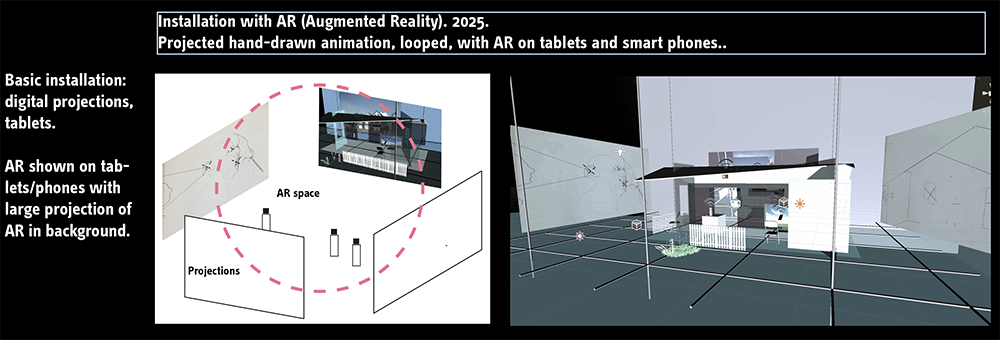
This immersive exhibition has three components: a central 3D-rendered “house” installation, a series of looping hand-drawn animations, along with tablets with the AR version of the house. This includes an introduction to subject matter, including visuals from the original Supersurface work (used with permission) and a QR code linking to the AR.
The projection/AR evokes the aesthetic of television soundstages, Embedded within the house are visual cues of contemporary digital life—smartphones, tablets, 4K displays, and smart home devices. Three iPads on pedestals allow visitors to explore the virtual house.
The looped animations explore themes such as surveilance, fragmentation, etc.