


Undergraduate, Graduate, and Collaborative Labs outside of the US
TEACHING North Carolina State University and Prior.
In graphic design, user content/contributions are often part of looking at designing in larger systems environments.
What we think of as separate subjects or disciplines in academia is actually interconnected in cultural practices and user scenarios as part of designing in large systems.
Through 2006, I developed courses and worked with students based on my original area of expertise at NCSU.
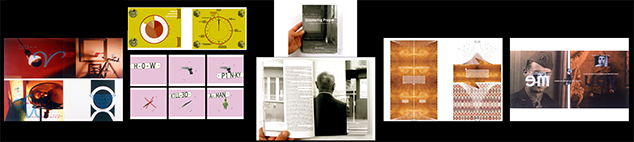
Between 2006 and 2010, the curriculum shifted to a very different educational philosophy based on designing in large overlapping systems of users, contexts, interaction, branding and service. Therefore over this period I had to redefine what and how I taught.
I worked to introduce interaction design and information visualization and methodology tied to user issues. This included motion and gesture in interface design, thinking through multiple touchpoints in a service environment, and users with different needs to design for in terms of accessibility.

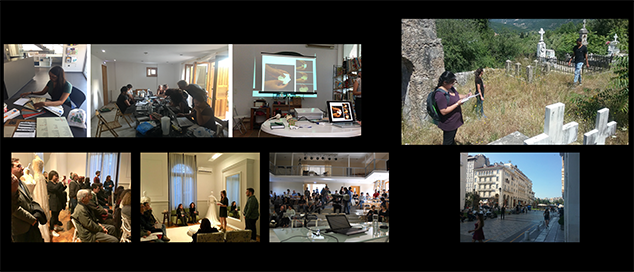
In 2017 I offered the first international experience in design and social innovation, that allowed me a certain autonomy to build on our approach to large overlapping considerations of context, while introducing a very different framing for design than our regular curriculum.
One of my collaborators in Greece, Maria Patsarika (PhD Sheffield: Sociology and Architecture; learning, participation and place-making; co-design and community engagement) and I formed a collaborative interdisciplinary approach to design and education including service learning.
Making images (so-called imaging courses in parallel to typographic courses)
I. Beginning sophomore
Introduction to applied semiotics especially as a way to ideate communicative visuals. Introduction to basic software use. Photography (staging a photoshoot) montage (previsualizing components and then combining into a single composition) “symbol” (images simplified and reduced based on gestalt principles).

II. Intermediate sophomore
Introduction to sequence tying into history of GD in photo essays layouts, and visual editing, film title work. Simple rubrics like McCloud that condensed down simple film ideas from precedent. Eisenstein and sequential montage ideas. Order and organization of visual books and K. Smith. Timelines as clear examples of storytelling: simple, comparative, granular.

III. Junior/senior
Synthesis of above, intro film title work looking at simple ideas that “hold” a segment together including gesture as sign, in other words thinking through objects in motion as creating a "scratch track" that can be applied to typographic movement (later applied to simple visual branding). Also create short vids with scripts and audio using comparative ideas, for example "deep time" as a parallel to “Powers of Ten” with simple analogies often performed or demonstrated.
(link)


Studio work
I. Early sophomore studios. Introductory ideas and curriculum-wide framework of interaction service and branding.
Objectives: introduce complexity at an early level based on a curricular-wide scaffold. My interpretation of this put students in situational experiences where equal weight is given to observation and documentation with simple interpretation rubrics. My goal is to reflect other viewpoints about complexity especially applying ideas from sociologist Anthony Giddens about "structuration"(think feedback/feedforward loops with a lot of variability in how things are used and interpreted by "users-" with unexpected outcomes,but also unexpected discoveries, empathy, attempts to avoid objectifying others, or deny their agency). Or as per Giddens: "agency and structure in which primacy is granted to neither."

II. “Design and social innovation” courses. Primarily service design ideas in a larger, participatory context via Manzini.
Objectives: how does this kind of variable complexity be applied to designing? How to get participation by "users" into the mix, how to move from qualitative and participatory research into design scenarios that are owned by participants, use available in-kind resources?
A second set of objectives: how to again change the underlying assumptions in GD/UX of a single "persona," to see people in relationships to their environment and to each other in design solutions. Example: reading ethnographic work on the experiences of visually impaired people in specific environments (rather than reading the distilled persona from a brief only). In the Study Abroad courses, students saw the gaps in their interpretations of "users," could not easily and unconsciously make assumptions about who they were designing for, no "cardboard history," or "cardboard" personas and presentation scenarios.
a. The use of human geography and simple ideas of ArcGIS.
b. Reading specific ethnographies.
c. Working in a different culture and language: immersion.